Plumage, Personalities, and Park Drama
A Closer Look at the Flock
I've told you to look at the ground, now look up. To those gliding wings moving across the sky with coordinated flight dynamics, the contrast is immediate. In My Journey in Organism Care, I discussed the importance of the creatures beneath our feet. Now it's time to share observations of desert grackles (Quiscalus mexicanus), rock pigeons (Columba livia domestica), red-tailed hawks, and other avian species I encountered during my sessions.
In the early days of April 2025, I began visiting the park with an investigative focus. I missed the steady, rhythmic hum of nature I'd grown used to in Kentucky, and I wanted to reconnect with the surrounding wildlife. I understood that insects and lizards moved beneath the surface of daily life, but I hadn’t yet grasped how active and complex the bird community was. Grackle calls, same-sex courtship displays, a hawk watching from above, and quick fusion-style flights all pulled me in. In a sense, I shifted from being the “crazy cat lady” to the “crazy bird lady,” observing how different organisms share space and interact.
Identifying Individuals
As they fed, I began noticing the stark differences between individual rock pigeons’ plumage (the color, pattern, and arrangement of feathers). Many people assume pigeons share the same gray coloration, though up close their bodies show a wide range of variation. Pigeons, like many organisms, display patterns shaped by age, wear, and environmental exposure.
Bartholomew stood out first. Pale patches were scattered across the neck and wings. White and cream markings along the upper body and head made this individual easy to track in the group. The mottling on the wings created clear contrast against the darker gray base feathers.
Ash, by contrast, looked more like the normalized “storybook” pigeon. The gray tones across the body formed a clean gradient from the dark head and neck to the lighter belly. Two dark wing bars were sharply defined and evenly spaced, giving Ash a more uniform appearance overall.
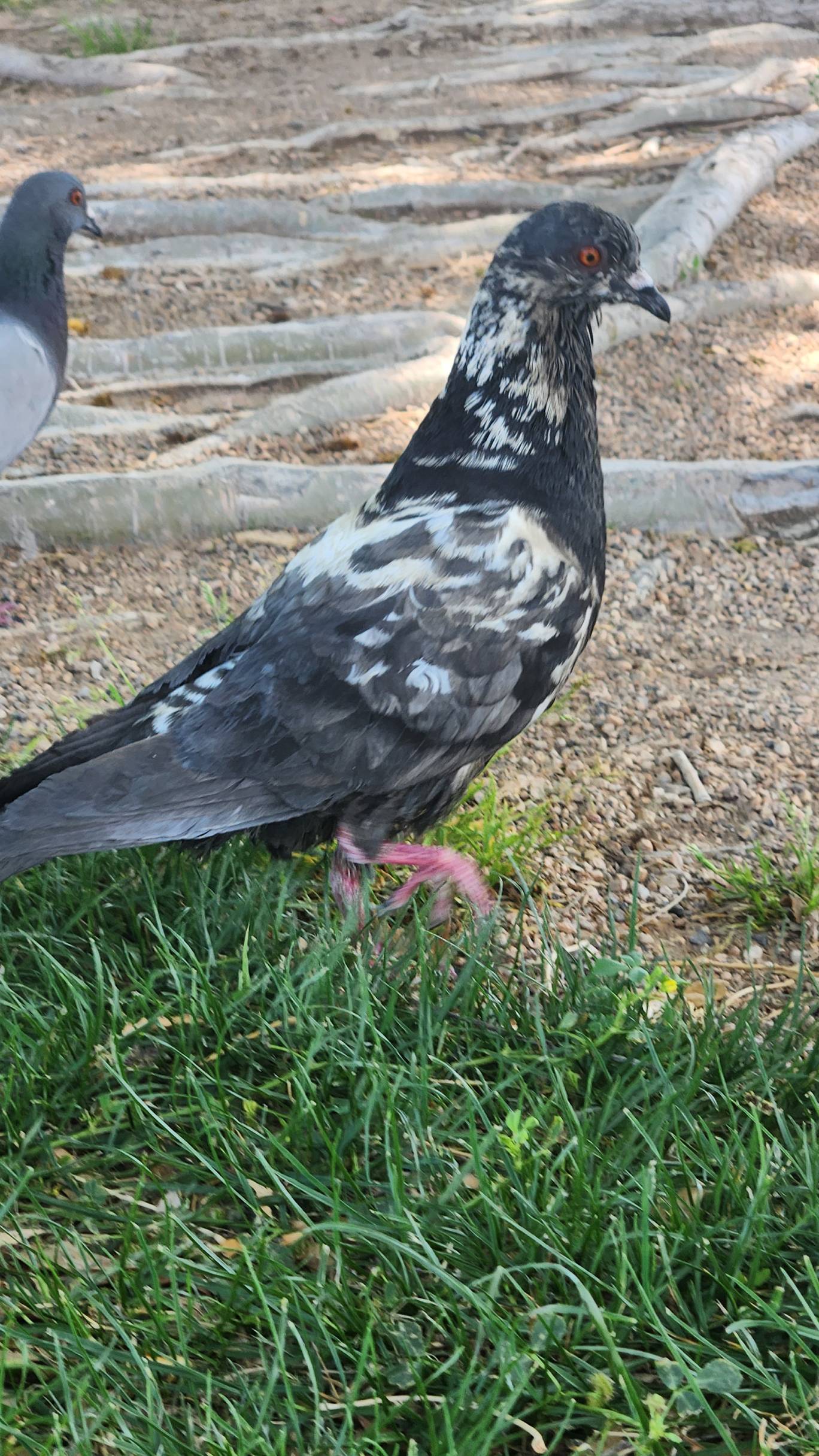
Bartholomew, early April observation day. Distinctive marbled plumage pattern.
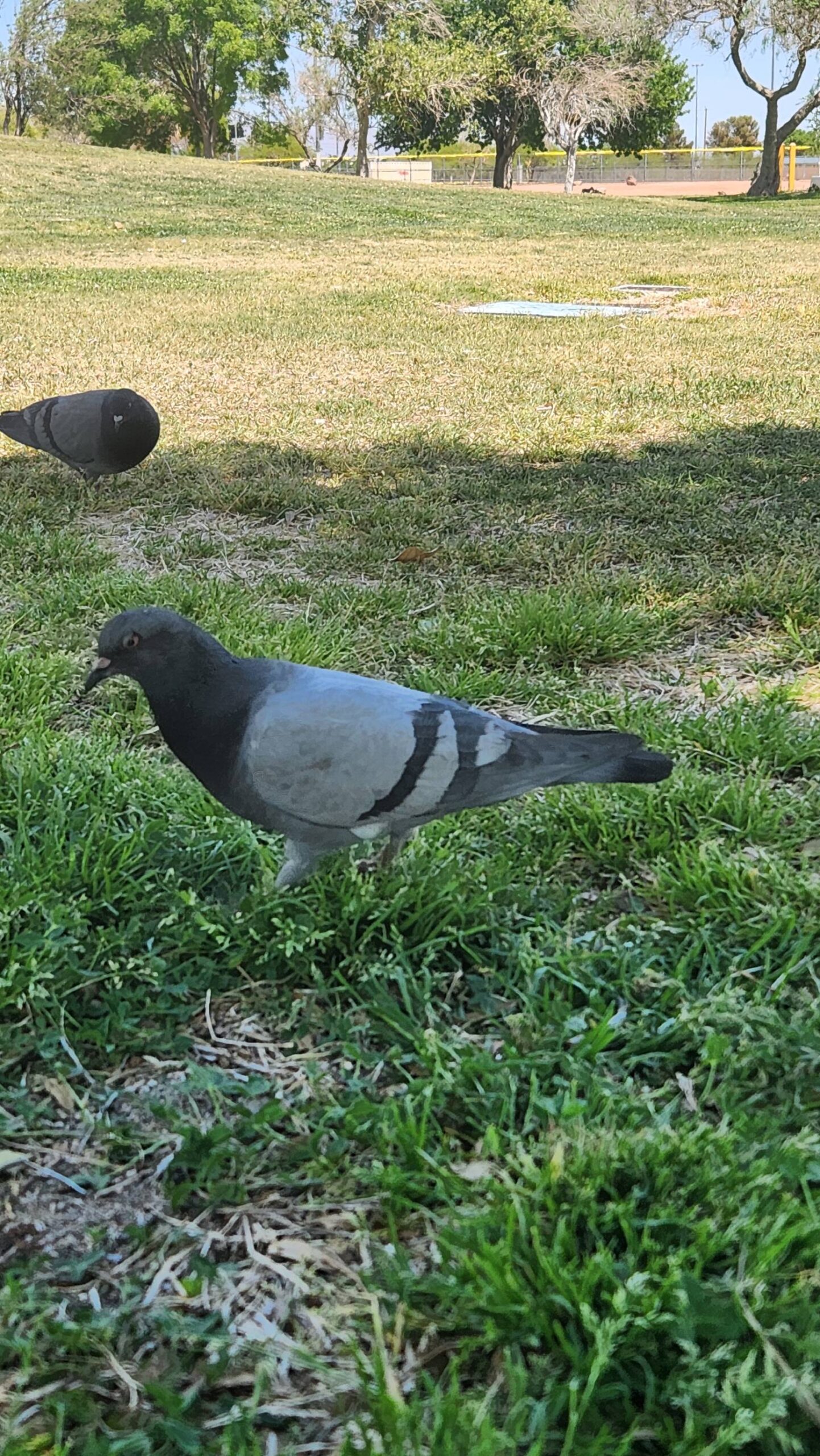
Ash — side profile view showing his clean two-bar wing pattern.
Resource Negotiation
A fight started brewing between Ash and Bartholomew. Bartholomew moved toward a small cluster of seeds about four feet from me, and Ash cut in immediately. Bartholomew attempted to grab a few grains from the edge of the pile, but Ash lifted his feathers and struck forward with a quick peck. They stood tense: shoulders raised, wings slightly angled, bodies tight.
For a few seconds, they advanced and retreated in sharp bursts, letting out short coos. I tried to interrupt the tension, but it didn’t matter. Their feathers flared in uneven puffs. Bartholomew stepped back first, moving toward the outer ring of the group. Once he pulled away, Ash lowered his feathers and returned to feeding near the main seed cluster.
The rest of the flock shifted position after the clash, spreading out toward the seed piles farther out. I observed for another fifteen minutes, feeding small amounts and noting details for my avian research project (more about that soon). Wind turbulence picked up, and the flock responded with a quick fission-fusion lift—a short collective takeoff that broke their formation before they regrouped farther downfield. About five minutes later, Ash returned alone, landing around four feet away with his neck turning as if checking for more seed. Bartholomew didn’t return. Once activity thinned and the flock drifted off, I packed up and ended the observation.
Summary and What’s Ahead
Even though the observation lasted a little over an hour, the session revealed more than I expected about flock behavior, individual decision-making, and how quickly pigeons negotiate access to food. I recorded several examples of flight behavior and collected usable images of the birds I encountered. This log is only one part of a larger body of work, field notes, recordings, and short analyses from multiple sessions.
This entry represents one of many observations from my ongoing hobbyist study of pigeon behavior and urban ornithology. While I’m not conducting this as formal research, my background in organism care and ecological documentation shapes how I approach these moments. Anyone interested in observation ethics, methodology, or data organization will find more information soon; I plan to publish at least one pre-print with supplementary datasets covering my continued work with urban bird communities.
If you’re curious about the next Bird Log—whether it’s the call I use when grackles arrive (a short food-associated cue) or how local predators interrupted later sessions—consider following my socials. You can subscribe to my RSS Feed or find me on Mastodon at @laya_wonders. There’s more to share, and more birds to meet; keep looking up!